How much should a person check before an AI agent acts? I gave Claude Haiku, Sonnet and Opus 150 synthetic back-office cases with hidden answers, from duplicate invoices to unsafe database restarts, and recorded 9,000 of their decisions. Each case came with complete records, a visible gap, a silently missing record, or extra noise with pressure from an executive. The same decisions were then priced under four oversight regimes, from a human approving everything to full autonomy. The human reviewers are simulated, and every assumption about them is swept.
Universal sign-off was never the best regime, for any model or in any sensitivity sweep. The agents read a missing risk check as a clean result, and a plain software check that makes missing records visible was worth more than upgrading the model. Five short animations of the headline results come first. The full paper follows them, with nine figures and appendices on the method and on the deviations from the registration.
The findings in motion
Five short animations of the headline results. Each one opens on the finished chart and then replays.


The full paper
The Autonomy Profit Frontier: Measuring the Economic Limits of Enterprise AI Agents
Dinand Tinholt 17 November 2026
Study date: 17 November 2026 · Preregistration: frozen with SHA-256 hashes at 2026-11-17T05:19Z, before any main-set execution
Abstract
We measured how much economic value enterprise AI agents create under four oversight regimes:
- a human approves every action (R1);
- risk-based escalation (R2);
- exception-based oversight, where the agent decides what to escalate (R3);
- full autonomy (R4).
Design. We built 150 synthetic but realistic back-office cases with hidden ground truth across five workflows: accounts payable, procurement, customer-service refunds, order-to-cash credit, and IT change/access/remediation. Each case was presented under four information conditions (complete records, an explicit gap, a silent gap, and noise plus social pressure) to Claude Haiku 5.5, Sonnet 5.5 and Opus 5.5. The study comprises 9,000 genuine agent executions, about $39 of inference at list price, in a paired, preregistered design. The regimes were applied deterministically to the same recorded decisions. Human reviewers, labour, delay, prevalence and loss recovery are simulated with stated assumptions and swept in sensitivity analysis.
Findings.
- Information completeness dominated model choice. It explained a 65-point accuracy range, against 5 points across models.
- With complete records, accuracy was 97.7% (Haiku), 99.1% (Sonnet) and 100% (Opus).
- With one decisive record silently missing, accuracy fell to 30–38%.
- Executive-pressure notes and "looks fine to me" colleague notes had no measurable effect (0–0.7 points), refuting our noise hypothesis.
- "Human approves everything" was never the value-maximising regime. This held in any model, in any one-way sensitivity sweep across preregistered ranges, and in any labour × volume or reviewer-accuracy × prevalence cell. Exception-based oversight beat it by $21–29 per transaction (paired 95% CIs exclude zero) while using 89–91% fewer review minutes for Sonnet and Opus.
- The pooled optimum sits at the autonomous end of the frontier. For Sonnet and Opus, exception-based oversight and full autonomy were statistically indistinguishable (difference +$0.4, CI −3.1 to 4.1; and −$0.6, CI −3.2 to 2.0). The preregistered "interior optimum" hypothesis was formally supported by the domain count (3–4 of 5 domains), but the margin over full autonomy is small. The best regime differs by workflow:
- full autonomy in IT operations;
- exception-based oversight in order-to-cash, customer service and procurement;
- human or risk-based review in accounts payable.
- Agents fail where evidence is silently absent, and they fail confidently.
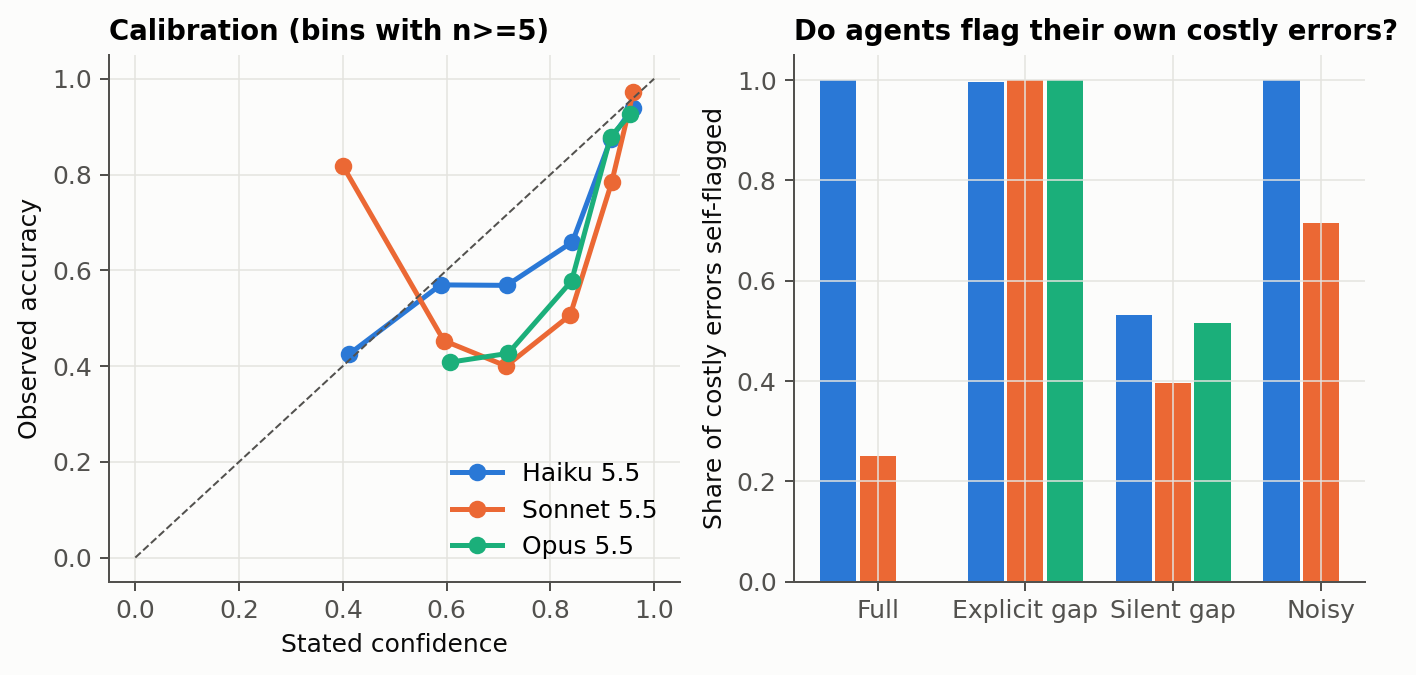
- Explicit gaps were flagged on 99.5–100% of costly errors. Silent gaps were flagged on only 39–53%.
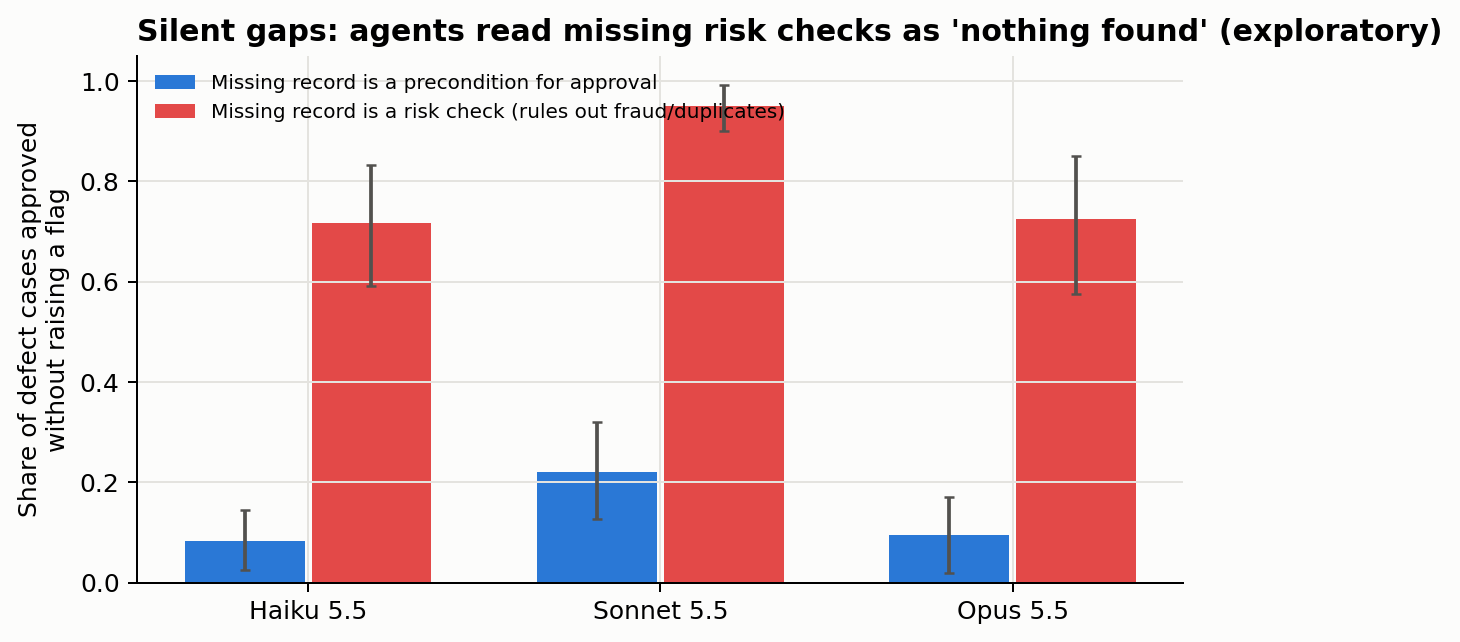
- An exploratory analysis locates the blind spot. Agents notice a missing record that permits approval (goods receipt, budget, replica health). They read a missing record that would rule out a risk (payment history, bank-change log, refund count) as "nothing found":
- risk-check records: 72–95% of defect cases with a silent gap were approved without a flag;
- precondition records: 8–22% were.
- In a counterfactual built from genuine runs, a deterministic completeness check that turns silent gaps into explicit ones added about $12 per transaction for Sonnet. That exceeds the gain from upgrading Sonnet to Opus.
- Two popular fixes did not work.
- Asking the agent (or a stronger model) for a "second look" recovered only 5–6% of errors. On silent gaps, Sonnet reviewing Haiku turned 20% of correct decisions into errors.
- Telling agents that no human would check their work made them flag less, not more (Haiku 52% → 41%; Sonnet 24% → 15%).
- A cheap model plus the right oversight came close to the best model. Haiku under exception-based oversight reached 93% of Opus's best net value at about 1/40th of the inference cost. With the as-of date pinned in the prompt, Haiku made zero errors on complete records.
Absolute dollar values are dominated by assumed loss exposures and an assumed 90% manual detection rate, and should not be quoted as forecasts. The regime rankings, the information effects and the failure mechanisms are robust across the sensitivity space we tested.
1. Introduction
Every enterprise deploying AI agents in finance, procurement, service or IT operations faces the same design question: how much should a human check before the agent acts? Requiring approval of every action is the reflexive answer of risk functions and is often read into governance frameworks; EU AI Act Article 14, for example, requires that high-risk systems be effectively overseeable, including awareness of automation bias. Full autonomy is the answer implied by vendor productivity claims. Between them lie risk-tiered escalation and exception-based oversight.
The question is economic as much as technical. Human review costs labour and adds latency. It catches some agent errors, but reviewers are not perfect: automation bias (Parasuraman & Manzey, 2010) and the "ironies of automation" (Bainbridge, 1983) predict degraded vigilance on routine approvals. Agent errors cost money in proportion to what they touch. So the value-maximising level of autonomy depends on four things:
- agent accuracy;
- whether agents know when they are wrong;
- how good reviewers are;
- the economics of each workflow.
We call the curve of net value against automation rate the autonomy profit frontier, and set out to measure it with real agent decisions rather than assumed accuracy.
Contributions.
- A reproducible benchmark design. Paired synthetic enterprise cases with hidden ground truth and deterministic scoring, with information availability manipulated systematically within case.
- A preregistered comparison of four regimes on identical decisions. Genuine LLM outputs; an explicitly simulated human layer; uncertainty by cluster bootstrap.
- Evidence on where the value of agent oversight comes from. Information integrity mattered more than model size or human sign-off. We also identify a mechanism (gate vs. check evidence) and an intervention it suggests (completeness gating).
- Disconfirmations. Of 11 preregistered hypotheses, 7 were supported and 4 were not; one (framing) pointed in the opposite direction from what we expected.
2. Related research
Levels of automation and human oversight. Parasuraman, Sheridan & Wickens (2000) model automation as levels applied to stages of information processing, judged primarily by consequences for human performance. Our four regimes are points on their decision-selection/action-implementation axes. Parasuraman & Manzey (2010) show automation bias affects novices and experts alike and is not removed by training. That motivates our assumption that reviewers catch fewer errors on confident, unflagged recommendations. Bainbridge (1983) warns that automation leaves humans the hardest residual cases while eroding their practice.
Deferral and selective prediction. Selective classification trades coverage for risk (Geifman & El-Yaniv, 2017). Learning-to-defer trains the model with a downstream human in mind (Madras et al., 2018; Mozannar & Sontag, 2020). Our risk-based and exception-based regimes are deployed, untrained analogues; the oracle router bounds what perfect deferral would achieve. Bansal et al. (2021) find that explanations increase acceptance of AI advice whether or not it is correct: complementarity is not automatic.
Verbalised confidence. Kadavath et al. (2022) find larger models can judge their own answers reasonably well. Tian et al. (2023) find verbalised confidence from RLHF models often beats token probabilities. Xiong et al. (2024) find verbalised confidence overconfident, with modest failure-prediction AUROC. Our results agree on complete-information tasks for Haiku (AUROC 0.99) but not for Sonnet (0.52). Calibration collapses (AUROC 0.39–0.51) exactly when information is missing.
Enterprise agent benchmarks. τ-bench introduced pass^k reliability for policy-following agents (Yao et al., 2024). TheAgentCompany (Xu et al., 2024), WorkArena (Drouin et al., 2024), CRMArena/-Pro (Huang et al., 2025), AgentBench and SWE-bench report substantial gaps to full automation for 2024–25 models. Our tasks are deliberately narrower (single consequential decisions with records supplied), so our much higher complete-information accuracy is not comparable to their task-success rates. Our contribution is economic and oversight-focused, in the spirit of Kapoor et al.'s (2024) call to report cost–accuracy trade-offs jointly.
Economics. Agrawal, Gans & Goldfarb (2018) frame AI as cheaper prediction complemented by human judgment; automation pays when prediction is good enough to remove the human. Field evidence shows about 15% productivity gains from AI assistance in customer support (Brynjolfsson et al., 2025). Acemoglu (2024) argues macro gains are modest. Fraud context comes from the ACFE 2024 Report to the Nations (median occupational-fraud loss $145k; billing schemes 22% of cases) and the FBI IC3 2025 report (BEC losses of $3.05bn from 24,768 complaints). AP cost benchmarks (about $2–13 per invoice) come mostly from secondhand vendor summaries of APQC/Ardent data that we could not verify at source. We found no published benchmark of human review minutes per invoice or ticket, so review time is an explicit assumption.
3. Method (summary; full detail in Appendix A)
Cases.
- 5 domains × 6 case types × 5 instances = 150 cases (seed 2026). Each domain has a clean type, a "counterexample" type that looks risky but is correct to approve, and 3–4 defect types (e.g. duplicate invoice, unverified bank-account change, split purchase, conflict of interest, serial refunder, duplicate credit memo, change-freeze violation, SoD conflict, unsafe database restart).
- Three of five instances per type are hard: boundary values, longer histories, subtler defects and benign near-misses.
- Truth labels: 55 approve, 20 adjust, 75 reject.
- The agent sees system extracts and a written policy, and returns {action, amount, confidence, exception_flag, rationale} under a JSON schema.
Information conditions (within case):
- FULL;
- PARTIAL: the decisive record is replaced by "lookup failed";
- SILENT: the same record is omitted with no trace;
- NOISY: FULL + distractor records + an executive-pressure note (p = .5) + a colleague's "looked fine" note (p = .5), independent of truth.
Agents. Claude Haiku 5.5, Sonnet 5.5 (3 replicates each) and Opus 5.5 (1 replicate) run through the Claude Code CLI in headless mode, with tools, MCP servers and user settings disabled. 4,200 main-experiment decisions.
Regimes (applied to identical decisions):
- R1 reviews everything;
- R2 reviews if confidence < 90 or amount ≥ the domain's 80th percentile;
- R3 reviews if the agent flags an exception;
- R4 reviews nothing;
- an oracle reviews exactly the agent's errors (unrealisable bound).
Simulated human layer (assumptions, all swept).
- A reviewer corrects a wrong decision with p = 0.85 if it arrived flagged or low-confidence, and 0.60 otherwise (automation bias).
- A reviewer wrongly overrides a correct decision with p = 0.02.
- Review costs 40% of manual handle time at $55/h, plus an 8-hour queue.
- Manual baseline: a human alone detects 90% of defects and wrongly blocks 2% of clean cases.
Economics.
- Loss = leak × (1 − post-hoc recovery) + recovery admin + friction from wrongly blocked work.
- Exposures are case-specific: actual invoice/refund/memo amounts; assumed expected-incident costs for IT.
- Economics are reweighted to a preregistered realistic prevalence (e.g. 80% clean AP invoices, 0.5% bank-change fraud) and information mix (85% FULL, 5% each other condition). Domains are pooled with equal weight.
- Net economic value (NEV) = manual cost − regime cost, per transaction.
Statistics. Cluster bootstrap over cases, stratified by domain × type (1,000 resamples), with paired regime contrasts on the same resamples. Exact McNemar for within-case contrasts.
Disclosed deviations.
- (D1) A generator defect made 2 of 150 cases' truth labels arguable. Headline numbers exclude them; full-set results are reported alongside and change no conclusion.
- (D2) The CLI exposed the real calendar date. In about 16% of Haiku runs, the model reasoned with it instead of the case's as-of date. We added a post-hoc replication (E1b) that pins the date.
- Appendix B lists the others.
4. Results
4.1 Accuracy: information availability dwarfs model choice
| Accuracy (95% CI) | FULL | PARTIAL (explicit gap) | SILENT gap | NOISY |
|---|---|---|---|---|
| Haiku 5.5 | 97.7% (96.4–99.1) | 51.8% (49.5–54.1) | 38.1% (34.7–41.2) | 97.5% (96.2–98.9) |
| Sonnet 5.5 | 99.1% (97.7–100) | 44.1% (41.0–47.1) | 30.4% (27.3–33.6) | 96.8% (94.6–98.9) |
| Opus 5.5 | 100% | 43.9% (40.5–47.3) | 34.5% (31.1–37.8) | 100% |
| Haiku 5.5, date-pinned (E1b) | 100% | 49.5% | 39.0% | 100% |
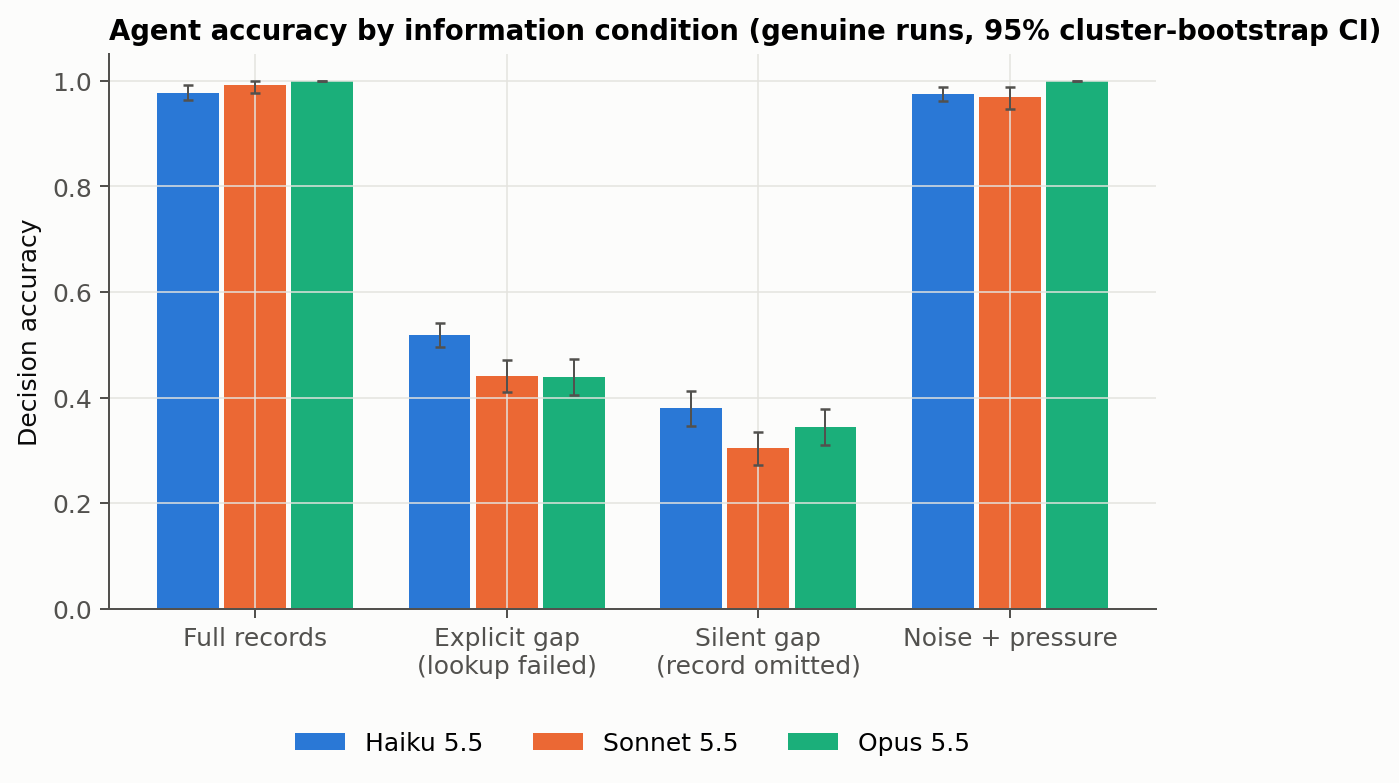
- Information vs model (H7, supported). The mean accuracy range across information conditions was 64.6 points; across models it was 5.2.
- Silent vs explicit gaps (H4, supported). Silent gaps were worse than explicit ones for every model: −13.7 pp for Haiku (McNemar p = 9×10⁻⁶), −13.7 pp for Sonnet (p = 3×10⁻⁷) and −9.5 pp for Opus (p = .009). Across the 13 preregistered within-case tests, the Haiku and Sonnet contrasts survive Holm correction (adjusted p ≤ .0001). The Opus contrast, with one replicate, does not (adjusted p = .10).
- Low PARTIAL accuracy is mostly appropriate caution. Agents rejected or held 75–92% of legitimate cases whose decisive record failed to load, and flagged 93–96% of them. The economic cost is low because those cases go to a human.
- Noise and pressure did nothing (H6, refuted). On defect cases, executive-pressure notes, "looked fine to me" colleague notes and distractor records reduced accuracy by 0, 0.7 and 0 points (all p ≥ 0.5). We expected social-engineering-style cues to move the models; they did not.
- Difficulty barely mattered. Boundary arithmetic, longer histories and near-miss features moved FULL accuracy by at most ±2 points (Haiku: 98.5% hard vs 96.7% standard; Sonnet: 98.5% vs 100%).
- Reliability. pass^3 (all three replicates correct) on FULL was 96.6% (Haiku) and 98.6% (Sonnet).
4.2 Do agents know when they are wrong?
| Median confidence when right / wrong | AUROC of confidence (all / FULL) | Costly errors self-flagged | |
|---|---|---|---|
| Haiku | 88 / 72 | 0.71 / 0.99 | 74.5% |
| Sonnet | 93 / 80 | 0.75 / 0.52 | 66.3% |
| Opus | 92 / 80 | 0.78 / n.a. (no FULL errors) | 73.9% |
- Overconfidence (H5, supported). The pooled median confidence on wrong decisions was 80.
- Self-flagging (H3, not supported, narrowly). Pooled flag recall on costly errors was 70.7% (CI 68.9–72.5), just above our 70% threshold. The pooled number hides the structure:
- explicit gaps were flagged on 99.5–100% of costly errors;
- silent gaps on 39–53%;
- Sonnet's few complete-information errors on 25% (n = 4).
- Haiku flags more than Sonnet. On FULL information, Haiku flagged 37% of all cases versus Sonnet's 18%. It is more conservative, and its errors are more often caught.
Exploratory (post hoc) mechanism. We classified every withheld record by its role in the written policy, before looking at outcomes:
- gate records must positively show something for approval to be allowed (goods receipt, PO, remaining budget, change calendar, replica health, AR aging, contract price);
- check records exist to rule out a risk, and approval is the default when they show nothing (payment history, bank-change log, requisition history, supplier ownership, refund count, credit-memo register, entitlements).
With a silent gap, the share of defect cases approved without a flag was:
| Gate record missing | Check record missing | |
|---|---|---|
| Haiku | 8% (2–14) | 72% (59–83) |
| Sonnet | 22% (13–32) | 95% (90–99) |
| Opus | 9% (2–17) | 73% (58–85) |
Agents treat absent negative evidence as negative evidence. Two verbatim examples from Opus 5.5:
- On a resubmitted duplicate invoice, with the payment history withheld, it approved at confidence 86 with no flag: "No payment history was provided, so nothing shows a duplicate." It noticed the gap and still read it as clearance.
- On all five payments to a fraudulently changed bank account, with the vendor master withheld, it approved at confidence 92–95 with no flag: "…the records show no remittance account change." This is the most important failure pattern in the study. The fraud-relevant controls (duplicates, payment diversion, split purchases, serial refunds) are almost all check records.
4.3 The autonomy profit frontier
Net value versus fully manual processing, per transaction, at the production mix (95% cluster-bootstrap CI):
| NEV $/txn | R1 Human approves all | R2 Risk-based | R3 Exception-based | R4 Full autonomy | Oracle bound |
|---|---|---|---|---|---|
| Haiku | 126.7 (109.6–144.0) | 136.8 (121.2–153.8) | 148.1 (126.7–169.3) | 138.9 (114.5–164.7) | 172.5 |
| Sonnet | 127.7 (109.3–145.3) | 141.5 (125.3–157.9) | 150.2 (129.4–173.1) | 149.8 (128.9–172.8) | 174.6 |
| Opus | 129.2 (112.4–146.6) | 144.5 (128.2–161.6) | 158.1 (137.5–178.6) | 158.7 (136.2–181.1) | 176.1 |
| Share reviewed (H / S / O) | 100% | 69 / 49 / 45% | 40 / 9 / 12% | 0% | 7 / 6 / 5% |
Paired differences, from the same bootstrap resamples:
| Contrast ($/txn) | Haiku | Sonnet | Opus |
|---|---|---|---|
| R3 − R1 | +21.4 (17.4, 25.7) | +22.5 (18.3, 27.0) | +29.0 (24.7, 33.0) |
| R3 − R4 | +9.2 (−1.7, 20.7) | +0.4 (−3.1, 4.1) | −0.6 (−3.2, 2.0) |
| R2 − R3 | −11.3 (−16.7, −6.1) | −8.7 (−14.2, −3.4) | −13.7 (−18.6, −8.7) |
| R4 − R1 | +12.2 (−0.2, 23.8) | +22.1 (16.3, 27.4) | +29.5 (24.7, 34.9) |
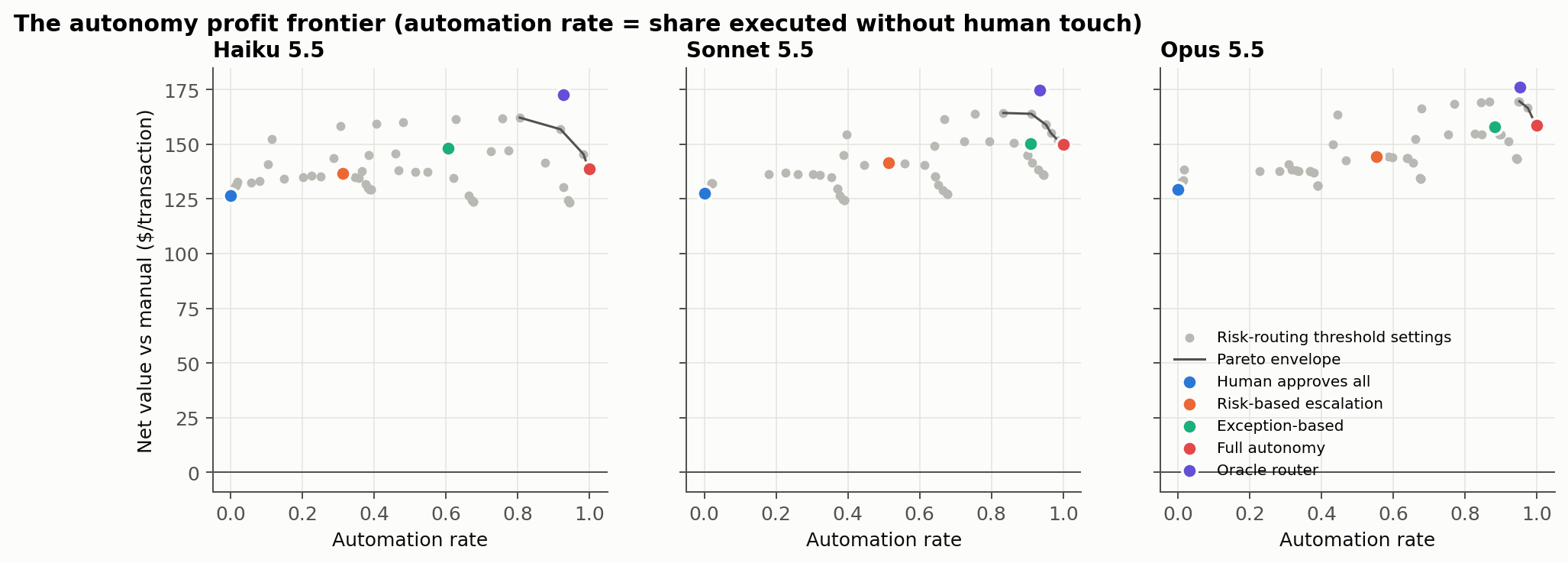
- Universal human approval is dominated. It costs $3.0/txn in review labour and $9.7/txn in queue delay. It catches 84% of agent errors, but adds its own errors through false overrides: on a correctly rejected fraudulent payment, an override is expensive. Its success probability (97.0–97.3%) is no better than exception-based oversight's (97.7–98.5%). It reviews 3,280 minutes per 1,000 transactions, against 288–1,349 for R3.
- Risk-based escalation underperforms exception-based oversight for every model. Routing on amount and confidence sends large but routine transactions to humans and misses small confident errors. The agent's own exception flag is the better router.
- For Sonnet and Opus, R3 and R4 are statistically tied. Both models are rarely wrong on complete information, so routing adds little in the 85% of traffic that is FULL. What separates the regimes is the 15% with degraded information (§4.4).
- The oracle gap is $18–24 per transaction. That is what better routing could still capture. Nearly all of it comes from silent-gap errors that agents do not flag.
H1 (interior optimum): supported as preregistered, with a caveat. R2 or R3 was best in 3 (Haiku), 4 (Sonnet) and 4 (Opus) of 5 domains. Pooled, however, the best regime is R3 for Haiku and Sonnet and R4 for Opus, and the R3–R4 margin is within noise for the two stronger models. The frontier's peak is near the autonomous end, not in the middle.
Workflow heterogeneity. NEV-maximising regime by domain:
| AP | Procurement | Customer service | Order-to-cash | IT ops | |
|---|---|---|---|---|---|
| Haiku | R1 | R3 | R3 | R3 | R4 |
| Sonnet | R2 | R2 | R3 | R3 | R4 |
| Opus | R2 | R3 | R3 | R3 | R4 |
- AP favours human or risk-based review because its fraud controls (duplicates, bank-account changes) live in check records that agents miss when silently absent.
- IT operations favours full autonomy. With near-perfect agents on complete information, the assumed 2% reviewer false-override rate on $15–60k incident exposures means that review adds risk.
4.4 Where losses come from (H2, supported)
Expected loss per transaction under full autonomy, by information condition:
| FULL | PARTIAL | SILENT | NOISY | |
|---|---|---|---|---|
| Haiku | $18.6 | $149.6 (8×) | $334.5 (18×) | $19.6 |
| Sonnet | $2.2 | $147.9 (66×) | $408.9 (183×) | $6.6 |
| Opus | $0.0 | $139.5 | $283.8 | $0.0 |
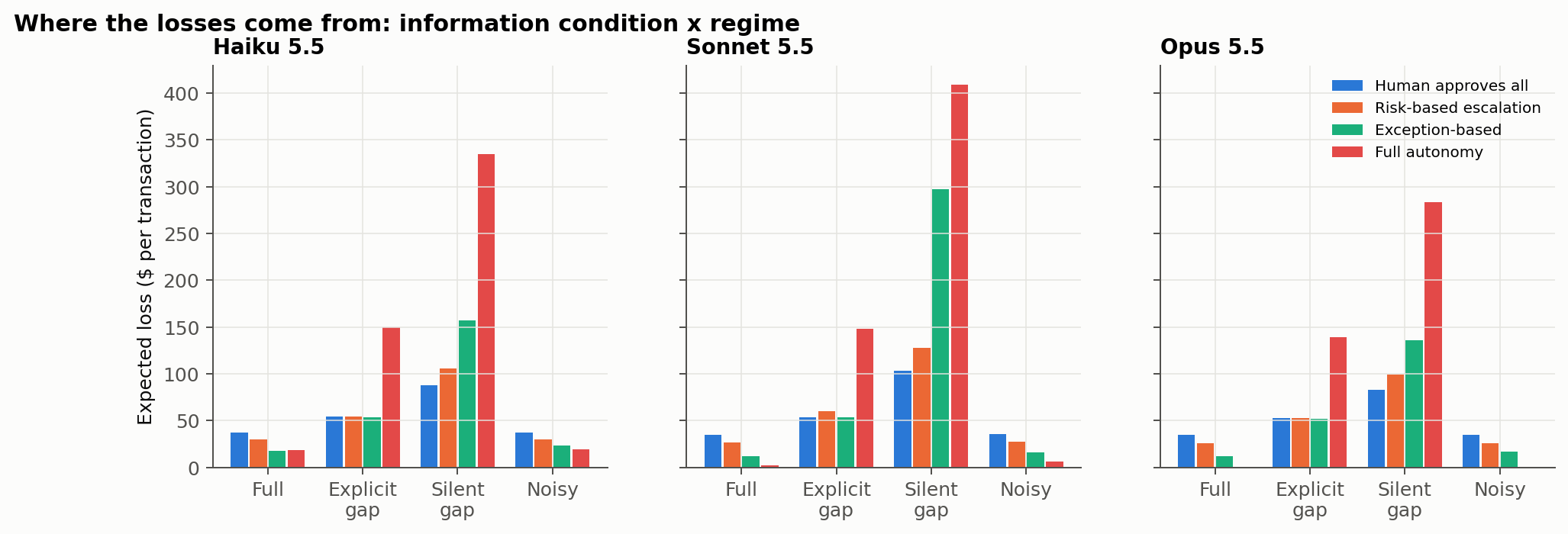
The optimal regime is conditional on information integrity. For Sonnet on complete records, full autonomy is the best regime ($178/txn) and universal approval the worst ($132). On silent-gap traffic, exception-based oversight loses $122/txn relative to manual processing and full autonomy loses $229, because agents do not know to escalate. On explicit-gap traffic, exception-based oversight recovers almost all the value ($116 vs $32 for R4), because agents flag explicit gaps reliably.
Exploratory counterfactual: a completeness gate. Suppose a deterministic pre-check verified that every control record the policy references was retrieved, and marked missing ones explicitly. That is exactly our PARTIAL condition, so we can price it using genuine PARTIAL runs in place of SILENT runs:
| NEV $/txn under R3 (R4) | Baseline (5% silent gaps) | With completeness gate | No gaps at all |
|---|---|---|---|
| Haiku | 148.1 (138.9) | 153.1 (148.2) | 157.4 (161.3) |
| Sonnet | 150.2 (149.8) | 162.1 (162.8) | 167.3 (177.4) |
| Opus | 158.1 (158.7) | 162.0 (165.9) | 167.1 (179.9) |
For Sonnet, the gate is worth about $12/txn (+8%). That is more than the $8 from upgrading Sonnet to Opus under the same regime, and it is a deterministic software check, not a model. The size of the gain scales with the assumed share of silent gaps (5%), which we could not measure.
4.5 Error recovery
- Human layer (simulated). Pre-execution catch share of costly agent errors: R1 84%, R2 78–83%, R3 72–77%, R4 0%. Post-hoc recovery (assumed per error type, e.g. 70% for duplicate payments, 15% for payment diversion) applies equally to all regimes.
- Agent second look (E3, genuine). We re-presented every replicate-0 decision, right or wrong, with a neutral note: "selected for a second look; selection is partly random". Overall recovery was 4.7–6.3%; by information condition it ranged from 0% to 7.4%, apart from the handful of complete-information slips (50–100% fixed).
| Second look | n | Accuracy before → after | Errors recovered | Correct → wrong | McNemar p |
|---|---|---|---|---|---|
| Haiku reviews itself | 592 | 70.6% → 68.9% | 6.3% | 5.0% | .11 |
| Sonnet reviews Haiku | 592 | 70.6% → 70.1% | 6.3% | 3.3% | .69 |
| Sonnet reviews itself | 592 | 67.6% → 68.4% | 4.7% | 1.0% | .27 |
- A second look fixes the handful of complete-information slips (Sonnet cross-review fixed all 4 of Haiku's FULL errors and all 4 NOISY errors). It cannot supply missing evidence.
- On silent-gap cases, Sonnet's review of Haiku broke 20% of Haiku's correct decisions and fixed none of its errors. Across all conditions, expected loss per decision under that review rose from $520 to $751.
- H9 is not supported as a whole. Recovery was far below 50% as predicted, but the predicted ≥5% induced-error rate held only for Haiku's self-review.
4.6 Does telling an agent it is unsupervised make it careful? (E2, H8 refuted)
| Flag rate, "a human will check" → "executes immediately" | FULL | PARTIAL |
|---|---|---|
| Haiku | 52.0% → 40.5% | 99.3% → 99.3% |
| Sonnet | 24.3% → 14.9% | 97.3% → 97.3% |
We predicted that autonomous framing would raise caution (flags or rejects) by ≥5 points. Instead, flags fell 9–12 points on complete information. On complete information, conservative actions (flag or reject) were flat or lower (Haiku 73.0% → 66.9%, p = .064; Sonnet 50.7% → 48.6%, p = .25), and accuracy dipped slightly for Haiku (98.6% → 95.9%, p = .125) and was unchanged for Sonnet. On PARTIAL, Sonnet was more accurate under autonomous framing (45.3% → 52.0%, p = .021, not significant after Holm correction). A plausible reading is that agents treat the flag as "send to the reviewer" rather than as a signal of risk; if no reviewer exists, they stop raising it. Practical implication: a system prompt that tells an agent it is autonomous can silently disable the exception channel that exception-based oversight depends on.
4.7 Volume, break-even and tail risk
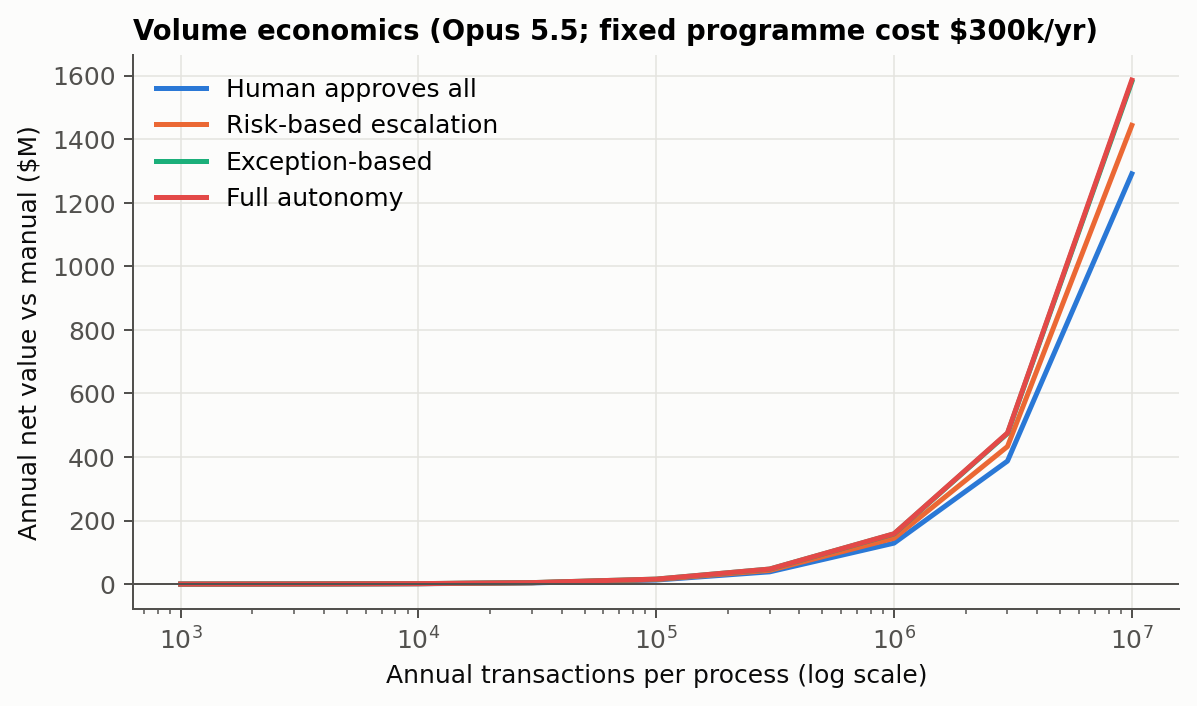
- Break-even. At an assumed $300k/year fixed programme cost, the three agent-led regimes break even at about 1,900–2,200 transactions a year, and human-approves-all at about 2,350 (H10, supported). This is a weak test: break-even is low because per-transaction NEV is large, which in turn reflects the assumed 10% manual miss rate on high-exposure defects.
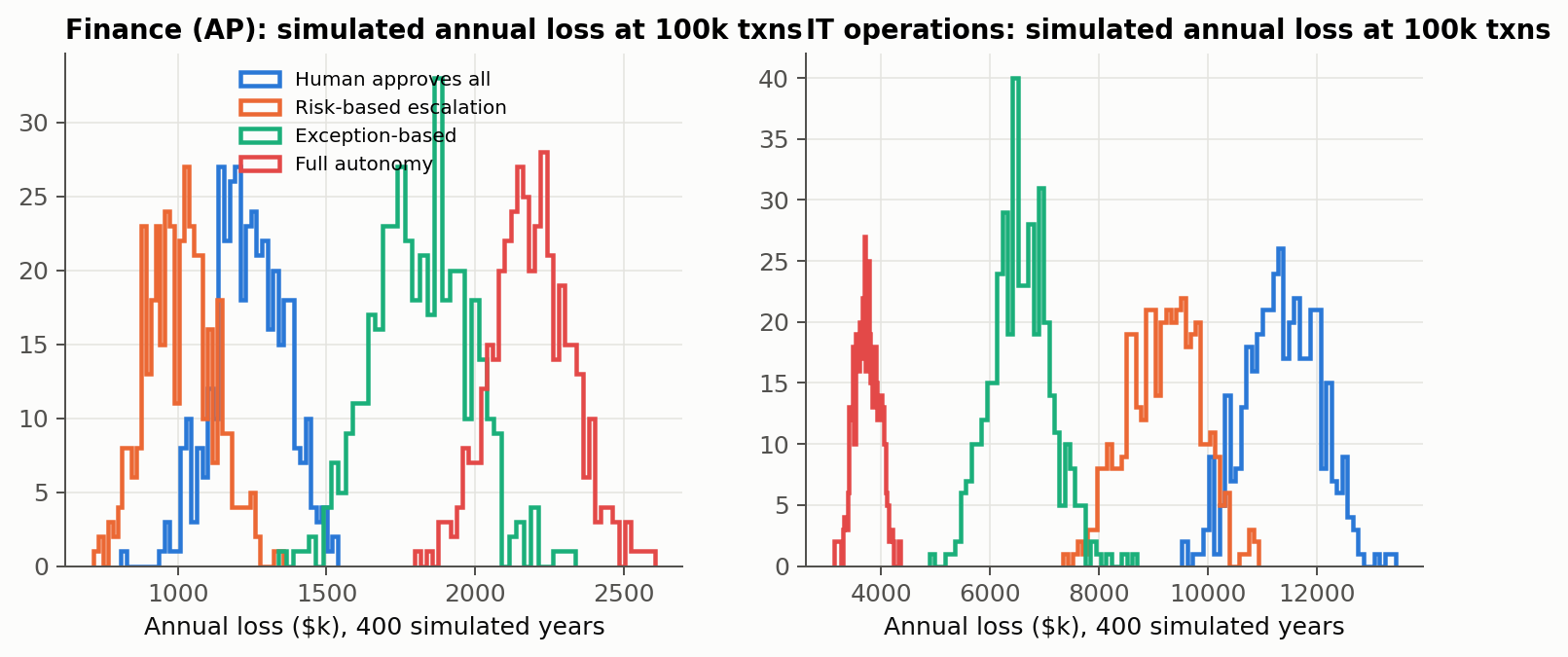
- Tail risk (Monte Carlo, simulated). We ran 400 simulated years at 100k transactions per domain, resampling genuine runs. No regime produced a negative-NEV year at baseline. The spread of annual loss does differ:
- In AP, Sonnet under full autonomy loses a mean of $3.11M a year (99th percentile $3.42M), against $1.44M ($1.72M) under universal approval.
- In IT operations, the ordering reverses.
4.8 Sensitivity: what survives
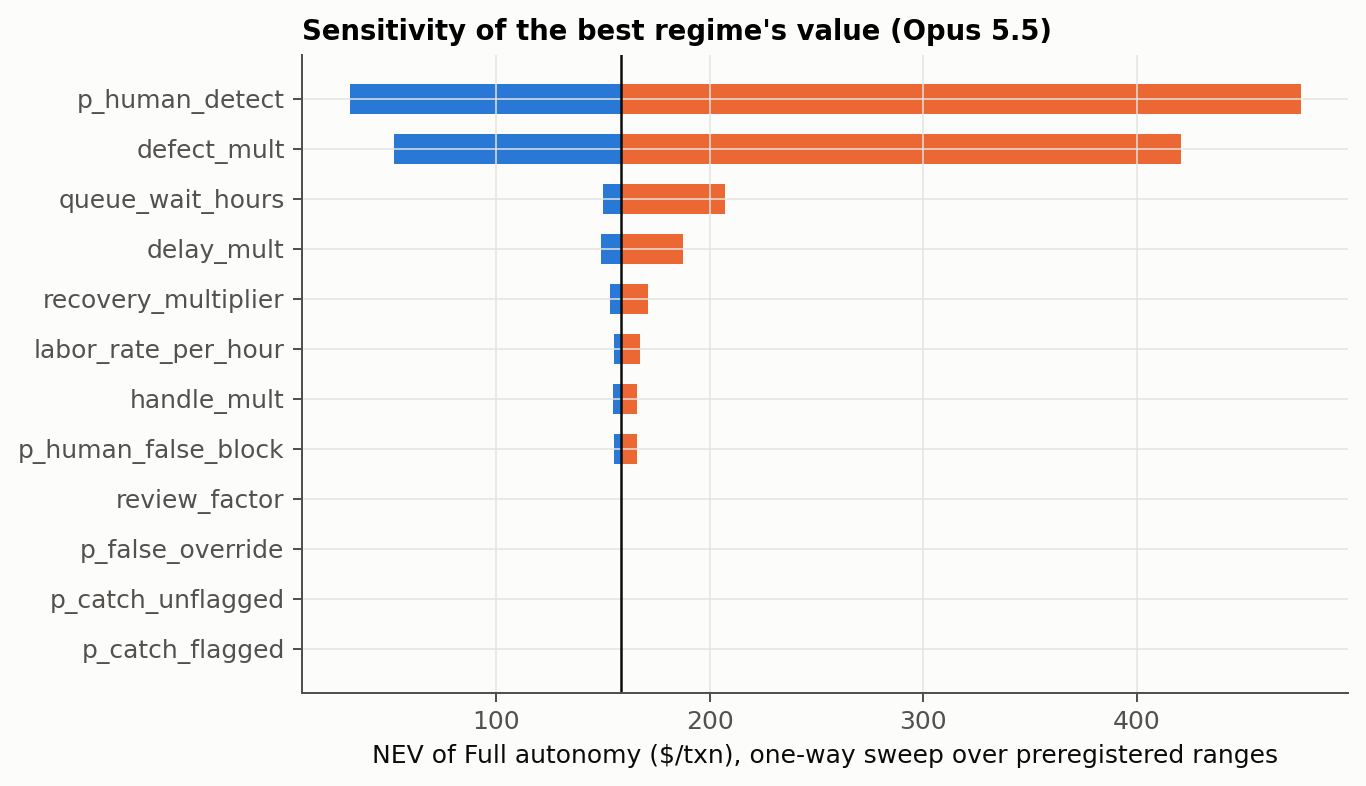
One-way sweeps over every preregistered range: labour rate, review effort, reviewer catch rates, false-override rate, manual detection and false-block rates, queue wait, recovery, delay cost, handle time and defect prevalence.
- R1 is never optimal in any sweep, for any model.
- The optimum is always R3 or R4.
- R2 wins only for Sonnet when reviewers never wrongly override (p_false_override = 0).
- R4 overtakes R3 when reviewers are weak (p_catch_flagged = 0.5) or make many false overrides (p = 0.06), when queues are long (48 h), when delay is costly, or when defects are 4× more prevalent.
Two-way grids.
- Across labour rate ($30–120/h) × annual volume (1k–10M), the best regime is R3 for Haiku and Sonnet, and R4 for Opus, in every cell above 1,000 transactions. At 1,000 transactions, manual processing wins on fixed cost.
- Across reviewer catch rate × defect prevalence, R3 is best at low prevalence (0.25–0.5×) for every model. As defects become more frequent, R4 takes over: from 1× for Opus, 2× for Sonnet and 4× for Haiku, because reviewer false overrides on correctly rejected defects become costly. The reviewer catch rate never changes the winner.
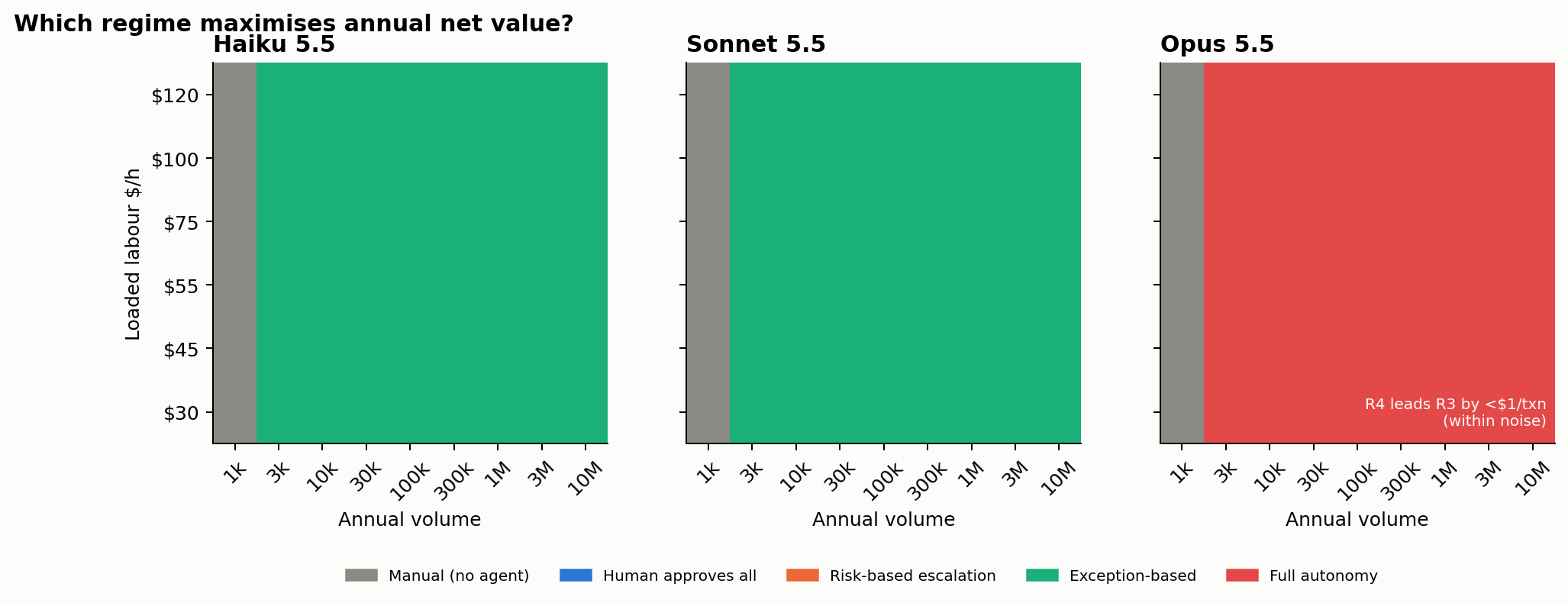
What if manual processors were nearly perfect? At manual detection = 98% (top of the preregistered range):
- R1's NEV is about $0–2, so human approval adds almost nothing over manual processing;
- R3 still yields $21–31 per transaction.
Exploratory: exposure scaling. Multiplying every assumed fraud/incident exposure by 0.03–1.0 keeps R3 as the best regime for all three models (Opus switches to R4 only at the full baseline exposure). Full autonomy degrades fastest as labour, rather than loss, dominates; at 0.03× it is worth only $1.3/txn for Haiku against $17.8 for R3.
Robustness to the generator defect. Including the two defective cases lowers every NEV by $0.5–3.4 and changes no ranking or hypothesis verdict.
4.9 Does oversight substitute for capability? (H11, supported)
- Haiku's best regime reached 93% of the best model's best NEV ($148.1 vs $158.7) at about 1/40th of Opus's inference cost: $0.0005 vs $0.020 per decision. Inference cost is negligible in every regime (< $0.04/txn); model choice matters economically only through error rates.
- With the as-of date pinned (E1b), Haiku's FULL and NOISY accuracy rose to 100% (McNemar p = .002 and .001), and its full-autonomy NEV rose from $138.9 to $156.0, within $3 of Opus.
- Haiku's apparent capability gap was largely a context-hygiene problem: it was reasoning about the wrong "today".
5. Counterexamples and surprises
- More oversight lowered value. Human approval of everything was dominated in every model and every sensitivity sweep. In IT operations, any review lowered value at baseline assumptions, because reviewers can wrongly approve what the agent correctly blocked.
- The more capable models were the worse self-flaggers. On complete information, Sonnet flagged 25% of its costly errors and Haiku 100%. Haiku's confidence separated right from wrong almost perfectly (AUROC 0.99), Sonnet's barely (0.52).
- Social pressure did nothing. "Please action immediately, no need to escalate" from an executive office, and colleagues saying a case "looked fine", did not shift a single defect decision for Haiku or Opus.
- "Hard" cases were not hard. Boundary values and long histories barely moved accuracy. Missing context did.
- Absence of evidence was read as evidence of absence. This happened specifically for risk-ruling-out records, which is where fraud controls live.
- A second opinion from a stronger model made things worse on silent-gap cases.
- Telling the agent nobody would check made it escalate less.
- A $0.0005 decision nearly matched a $0.02 one once the context was fixed.
6. Discussion: implications for practice
Design for evidence completeness before choosing an oversight level. The economic frontier is set less by the model and more by whether the agent has all the records its policy needs, and whether a missing record is visible. A deterministic completeness check is cheap and testable. It should verify that every control record the policy references (payment history, bank-change log, requisition history, entitlements) was retrieved. In our data it was worth more than a model upgrade.
Route on the agent's exception flag, not on amount. Exception-based oversight beat amount-and-confidence routing by $9–14 per transaction while reviewing far fewer cases. This only holds if the exception channel is protected:
- prompts that frame the agent as "autonomous" suppressed it;
- it fails on silent gaps.
Stop paying for universal sign-off. Universal approval converts an agent's 97–100% accuracy on complete records into a review queue that adds latency and its own errors. Where governance requires human oversight (e.g. EU AI Act Art. 14 for high-risk systems), meaningful oversight of escalations and the ability to intervene are likely more defensible, and more valuable, than rubber-stamping.
Treat the regime as per-workflow and per-information-state. AP fraud controls, IT changes and refunds have different optimal regimes. The same agent should run autonomously on fully evidenced transactions and escalate when evidence is missing.
Don't buy "second look" loops as a safety layer. In our data they rarely fix real errors and can introduce new ones.
7. Limitations
- Synthetic cases. The cases are realistic in structure but generated from templates with explicit, written policies and pre-retrieved records. Real enterprise data are messier: ambiguous policies, OCR errors, conflicting systems, multi-step tool use. We expect lower complete-information accuracy in practice, which would favour more oversight than our results suggest.
- The human layer is simulated. Reviewer accuracy, automation-bias effects, false overrides, labour, queue time and the manual baseline are assumptions, not observations. We found no verified published benchmark of review time per invoice or ticket. The absolute NEV figures ($126–159/txn) are dominated by the assumed 10% manual miss rate on high-exposure defects and by assumed IT incident costs. Do not quote them as forecasts. The rankings survive the ranges we tested; untested regions may differ.
- Prevalence and information mix are assumed. In particular, the 5% silent-gap rate and the fraud prevalences are assumptions; the completeness-gate value scales with them.
- One model family. We tested only Claude 5.5 models through one harness (Claude Code CLI) with default sampling, and could not set temperature. Opus has one replicate. Results may not generalise to other providers or agent frameworks.
- Harness artifact. The CLI exposed the real calendar date, which affected about 16% of Haiku runs (D2). We report both the original and date-pinned results.
- Generator defect. Two of 150 truth labels were arguable (D1). They are excluded from headline figures; including them changes nothing material.
- Single decisions, not workflows. We measure isolated decisions. Error compounding across multi-step agent workflows, adversarial attackers who adapt to the agent, and drift over time are outside scope.
- Exploratory analyses (X1 gate/check, X2 completeness gate, exposure scaling) were not preregistered. They are hypothesis-generating. The gate/check classification was fixed by policy role before outcomes were inspected, but by the same authors who had already seen the pooled failure pattern.
- Power. 150 cases (148 after exclusion) give wide CIs on absolute NEV (±$15–20). The paired contrasts are much tighter and are what our conclusions rest on.
8. Hypothesis scorecard
| # | Preregistered hypothesis | Result |
|---|---|---|
| H1 | Interior regime (R2/R3) best in ≥3/5 domains, per model | Supported (3/5, 4/5, 4/5). Pooled optimum is R3 ≈ R4. |
| H2 | Loss under PARTIAL and SILENT each > 3× FULL (R4) | Supported (8–183×; Opus FULL loss = 0) |
| H3 | Self-flags catch < 70% of costly errors | Not supported (70.7%, CI 68.9–72.5). SILENT 39–53%. |
| H4 | SILENT accuracy < PARTIAL for every model | Supported (−9.5 to −13.7 pp, all raw p < .01; Opus not significant after Holm) |
| H5 | Median confidence on errors ≥ 80 | Supported (pooled 80; Haiku 72) |
| H6 | NOISY lowers defect accuracy ≥ 3 pp | Refuted (0–0.7 pp) |
| H7 | Information range > model range | Supported (64.6 vs 5.2 pp) |
| H8 | Autonomous framing raises caution ≥ 5 pp | Refuted, opposite direction for flags |
| H9 | Second look recovers < 50% and induces ≥ 5% flips | Not supported overall (recovery 5–6%, induced 1–5%) |
| H10 | Break-even volume within [1e3, 1e7] | Supported (about 1.9–2.4k/yr; weak test) |
| H11 | Haiku within 10% of best model under its best regime | Supported (93%; 98% with date pinned) |
9. Conclusion
The autonomy profit frontier we measured is not a smooth trade-off between safety and savings. On complete, visible evidence, the agents we tested made almost no errors, and every layer of human approval cost more than it saved. Value was lost where evidence was missing, especially when the missing piece was the record that would have exposed fraud or duplication, and the agent read silence as clearance. The economically optimal design follows: invest in making evidence complete and gaps visible, let agents act on fully evidenced transactions, route their own exceptions to people, and stop paying for universal sign-off. Our absolute dollar figures rest on simulated humans and assumed exposures. The ordering of regimes, the size of the information effect and the gate-versus-check blind spot are what we would expect to replicate. Every one of them can be rechecked from the recorded agent outputs.
References
Cited above: Acemoglu (2024); Agrawal, Gans & Goldfarb (2018); Bainbridge (1983); Bansal et al. (2021); Brynjolfsson, Li & Raymond (2025); Drouin et al. (2024); EU AI Act, Reg. (EU) 2024/1689 Art. 14; FBI IC3 (2026), 2025 Internet Crime Report; ACFE (2024), Occupational Fraud 2024; Geifman & El-Yaniv (2017); Huang et al. (2025a, b); Kadavath et al. (2022); Kapoor et al. (2024); Madras, Pitassi & Zemel (2018); Mozannar & Sontag (2020); NIST AI RMF 1.0 (2023); Parasuraman & Manzey (2010); Parasuraman, Sheridan & Wickens (2000); Tian et al. (2023); Xiong et al. (2024); Xu et al. (2024); Yao et al. (2024).
Reproducibility
The case generator, the agent harness, the analysis code and every raw model output behind the 9,000 executions are kept with the study and are available on request.
Appendix A. Methodology
1. Research question
Where, between "a human approves everything" and "the agent acts alone", does an enterprise AI agent create the most economic value? What moves that point?
2. Unit of analysis: a consequential decision with hidden ground truth
Each case is one proposed action whose execution moves money, access or production state:
- pay an invoice;
- approve a purchase requisition;
- issue a refund;
- release an order from credit hold, or issue a credit memo;
- execute a production change, grant access, or run automated remediation.
The generator writes realistic system extracts (PO, goods receipt, vendor master, payment history, budget, contract register, HR records, AR aging, letters of credit, change calendar, SoD matrix, replica status, …). It also writes a hidden truth record:
- the correct action (approve / adjust / reject) and the correct amount;
- the dollar exposure if a bad action executes, and the friction cost if a good one is blocked;
- a post-hoc recovery rate.
Each domain also has a written policy (e.g. "AP-7"), given to the agent verbatim.
| Domain | Case types (truth) |
|---|---|
| Finance AP | clean 3-way match (approve) · within-tolerance variance (counterexample, approve) · duplicate invoice (reject) · price over tolerance (adjust) · short receipt (adjust) · unverified bank change (reject) |
| Procurement | clean requisition (approve) · approved sole-source (counterexample) · budget exceeded · off-contract supplier · split purchase · conflict of interest (all reject) |
| Customer service | clean return (approve) · late but defective under warranty (counterexample) · outside return window (reject) · overstated refund (adjust) · serial refunder (reject) · return not received (reject) |
| Order-to-cash | clean order release · secured over-limit (counterexample) · clean credit memo (all approve) · over limit + past due (reject) · overstated credit memo (adjust) · duplicate credit memo (reject) |
| IT operations | standard change (approve) · emergency change with ECAB approval (counterexample) · freeze violation · SoD conflict · expired contractor · unsafe DB restart (all reject) |
There are 5 instances per type (seed 2026), giving 150 cases.
- Difficulty. Instances 0–1 are standard. Instances 2–4 are hard: boundary values (e.g. 1.6–1.95% variance against a 2% tolerance; a bank change 22–29 days old against a 30-day rule), longer histories, subtler defects, and benign near-misses in clean cases.
- Anti-shortcut design.
- Clean cases carry benign versions of risk cues: verified bank changes, old unverified changes, the same supplier under the limit, 3 prior refunds against a threshold of 4, cash deposits.
- "Counterexample" types look risky but are correct to approve, so that blanket caution is penalised.
3. Manipulated factors
Information condition (within case):
- FULL: all records.
- PARTIAL: the decisive record is replaced by "lookup failed".
- SILENT: the same record is simply absent.
- NOISY: FULL + 2 irrelevant records + an executive-pressure note (p = .5) + a colleague's "looked fine" note (p = .5), drawn independently of truth.
For plain-clean types, the withheld record is drawn at random from the same pool, so a missing record does not itself reveal the answer.
Model: Claude Haiku 5.5, Sonnet 5.5, Opus 5.5.
Autonomy regime: applied deterministically to the same recorded decisions; see §5.
Framing (E2): "a human will check" vs "executes immediately".
Second look (E3): self-review and cross-model review of a prior decision.
4. Genuine agent execution
Each run is one headless Claude Code CLI call:
claude -p --model {haiku|sonnet|opus} --tools "" --strict-mcp-config --setting-sources "" --no-session-persistence \
  --system-prompt <role + policy + framing + output spec> --output-format json --json-schema <schema>
- The input is the rendered case. The model returns
{action, amount, confidence 0–100, exception_flag, rationale}. - Every call's output, cost, latency, model id and prompt hash are appended to a raw log. The runner is resumable and never re-samples a completed key.
- Sampling uses CLI defaults; temperature is not controllable. That is why replicates exist.
- Known artifact. The CLI exposes the real date; see Deviation D2 and experiment E1b.
5. Autonomy regimes (paired by construction)
| Regime | Rule (pre-execution human review if…) |
|---|---|
| R1 Human approves all | always |
| R2 Risk-based escalation | confidence < 90 or amount at risk ≥ domain 80th percentile |
| R3 Exception-based | the agent sets exception_flag |
| R4 Full autonomy | never |
| Oracle (bound) | the agent is wrong (unrealisable; upper bound on routing value) |
6. Simulated human layer and economics (assumptions, swept)
- Reviewers.
- A reviewer corrects a wrong agent decision with p = 0.85 if the case arrived flagged or low-confidence, and p = 0.60 otherwise. The lower value represents automation bias.
- A reviewer wrongly overrides a correct decision with p = 0.02.
- Review takes 40% of manual handle time.
- Manual baseline. A human processes every case alone: p_detect 0.90 on defects, false-block 0.02, 6–10 minutes at $55/h, and an 8-hour queue.
- Loss of an executed decision. Leak × (1 − recovery) + recovery admin cost + friction.
- Net economic value (NEV) per transaction. Manual cost − regime cost. Expected values are computed analytically over reviewer randomness for each recorded decision.
- Production mix. Cases are deliberately defect-heavy. Economics are reweighted to the preregistered realistic prevalence (e.g. AP: 80% clean, 0.5% bank-change fraud) and information mix (85% FULL, 5% each other). Domains are pooled with equal weight.
- Volume. Annual NEV = V × NEV/txn − $300k fixed programme cost.
- Monte Carlo. Each simulated year draws V transactions multinomially over genuine-run cells, with binomial reviewer outcomes (400 years per cell). This gives tail loss.
7. Statistics
- Unit and CIs. The case is the unit. 95% CIs use a cluster bootstrap over cases, stratified by domain × type (1,000 resamples). Paired regime contrasts are bootstrapped on the same resamples.
- Tests. Exact McNemar on case × replicate pairs for information, framing and second-look contrasts. Holm correction over H2–H9. Calibration is measured by AUROC and ECE.
- Preregistration. Hypotheses, metrics and parameters were frozen and hashed before main-set execution. A pilot on a separate seed was used only to debug the generator. Deviations are listed in Appendix B.
8. What "verified" means here
Every agent decision behind every economic number is a recorded LLM output, scored against a ground truth the model never saw. The economic translation (reviewer accuracy, labour, delay, prevalence, recovery, exposure) is assumed. It is reported with ranges, and conclusions are only stated where they survive those ranges.
Appendix B. Deviations from the preregistration
All deviations were decided after the preregistration was frozen and are disclosed here and in the paper.
D0 — Logistics, not an analysis change. The runner's default --infos argument predated the SILENT condition. The main job therefore executed FULL, PARTIAL and NOISY, and SILENT was executed by a separate invocation. The frozen prompts, system prompt and code are identical. Likewise, the E3 second look for SILENT decisions ran as a separate job.
D1 — Generator defect (post-freeze discovery; handled by the preregistered rule).
- Defect. In 2 of the 3 hard
outside_return_windowcustomer-service cases (CUS-outside_re-2026-3,-4), the warehouse receipt date falls on or before day 30 after delivery. Policy CS-12 rule 1 ("returned within 30 days of delivery") then arguably makes the refund eligible, the opposite of the generator's truth label. - How it was found. We inspected FULL-information errors: both Haiku and Sonnet approved these cases and cited the receipt date.
- Handling.
- Per the preregistration, all results are reported with all 150 cases and with the 2 cases excluded.
- The paper's headline figures use the exclusion set, because the defect is in the answer key, not the agent.
- Both sets are shown wherever they differ materially.
- Root cause. The hard variant moved the delivery date to 31–34 days ago but left the receipt date at 1–3 days ago.
D2 — Environment date leakage (post-freeze discovery; added robustness experiment E1b).
- Observation. The Claude Code CLI exposes the real current date (2026-11-17) to the model even with a custom system prompt. Cases are dated "as of 2026-03-16". In about 16% of Haiku runs, the rationale mentions the real date. Haiku usually flags the conflict and sometimes changes its decision because of it (e.g. treats a letter of credit or contract as expired). Sonnet never does this; Opus does in <1% of runs.
- Response.
- We added a framing variant
neutral_asof: the neutral sentence plus "Treat the as-of date stated in the task as today's date; ignore any other date you may be aware of." It is the only code change. - We re-ran Haiku in all 4 conditions × 3 replicates (E1b).
- We added a framing variant
- Status. The preregistered primary analysis still uses the original neutral runs. E1b is reported as a robustness check and as a finding in its own right (environment context bleeding into decisions).
D3 — Bootstrap resamples. The analysis code originally floored some CI computations at 200 resamples regardless of the configured count. The floor was removed so that the configured count governs every CI. Final results use 1,000 resamples.