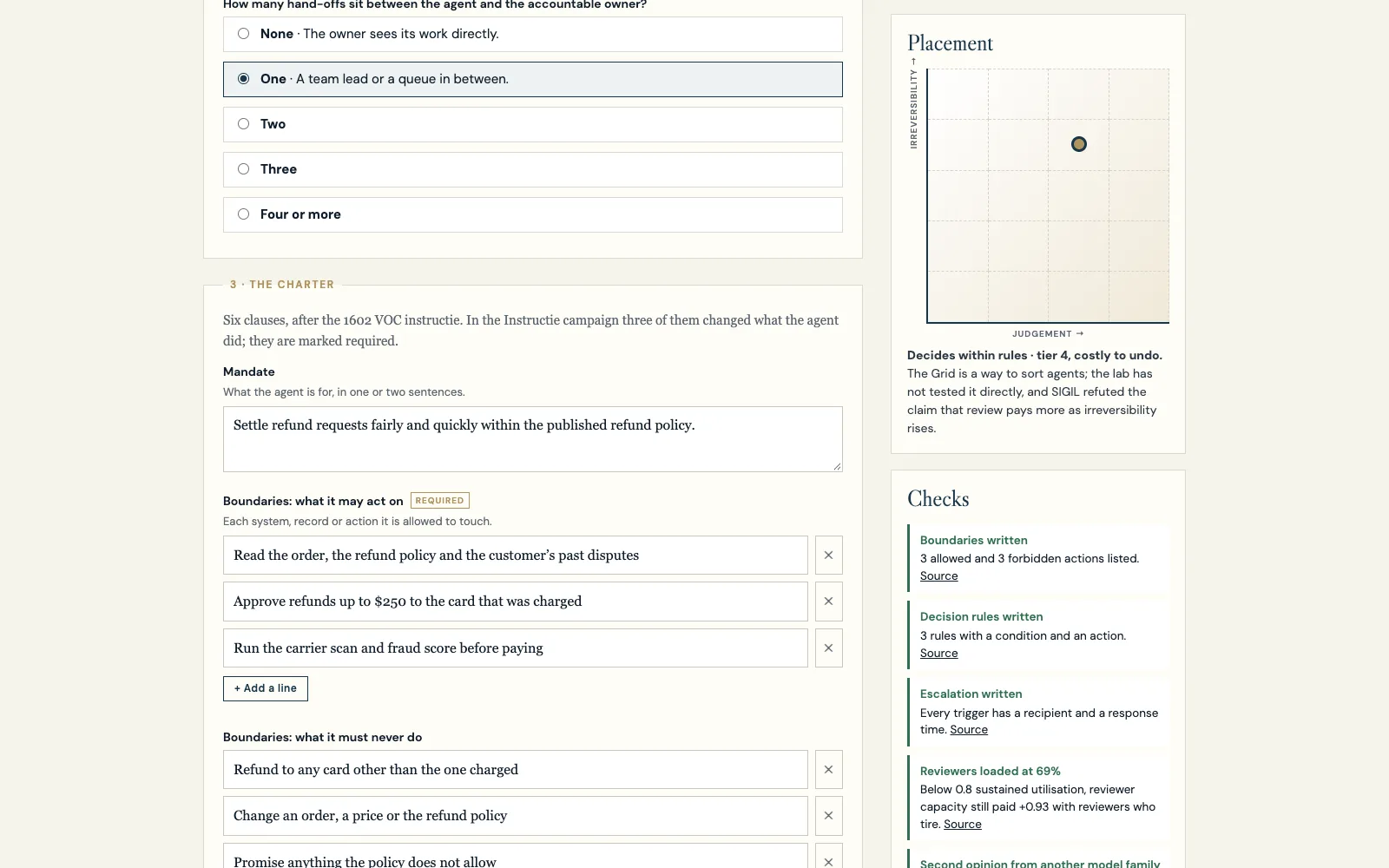
Charter Forge writes a delegation charter for an AI agent. You describe the agent, place it by how much judgement it exercises and how hard its mistakes are to undo, write the six clauses of its charter and size the oversight around it. While you type, a checks panel reads the charter against the lab’s published findings and links each warning to its study.
The framework
The clauses come from the instructie the Dutch East India Company issued in 1602, a document written to govern agents who sailed beyond the reach of timely correction: mandate, boundaries, decision rules, reporting, escalation conditions and revocation. In the Instructie campaign, removing boundaries, decision rules or escalation conditions changed what an agent did, and removing the other three had no measured effect. The tool marks those three as required.
Placement uses the two axes of the Cognition-Accountability Grid, with five tiers of irreversibility. The oversight checks apply the reviewer-utilisation limit from the Oversight Yield Curve, the cost of delegation depth from Delegation Cliff, the weakness of blocking review on irreversible actions from SIGIL, the case for a second opinion from another model family from Error Independence, the omission ledger from Trial Balance, and the fleet findings from Herding and sprawl cost.
How to use it
Load the example, a refund agent that may pay out up to $250 on its own, or start empty. The charter builds below the form as Markdown, ready to copy or download, with any open checks listed at the end. Save the JSON to pick the work up later.
What it does not do
The thresholds come from simulations and benchmarks with stated limits, and the Grid itself has not been tested by a campaign. Read a study before relying on its number. Everything you enter stays in your browser and is never sent anywhere.