The Delegation Ledger keeps a second book for your agents. An agent's log records what it did and has no line for a step it skipped. Here the dispatcher writes down each step an agent owes before it starts, and your tool executor records each run in the same file. The balance then shows only the lines where the two books part. It is a Python library with no dependencies, and the page here is its live view on a simulated procurement run.
What it does
Each owed step can carry an amount and a due time, and the dispatcher can close a task it is done with. Runs arrive through a separate handle that can't write obligations. Every line carries the hash of the line before it. Several processes can append at once under a file lock, and a long ledger rotates into sealed segments whose chain runs on unbroken.
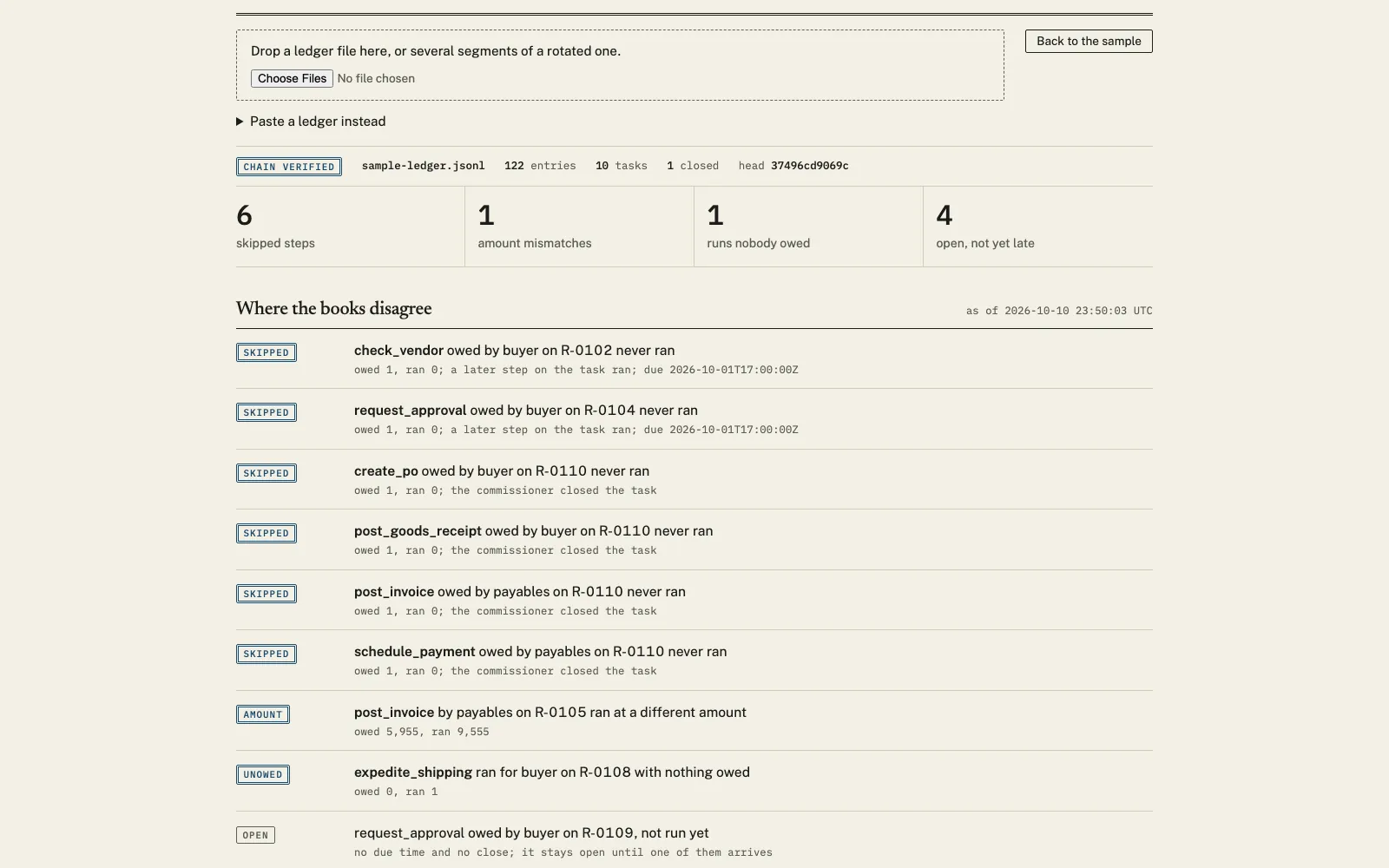
The balance names each line where the books disagree, such as a step owed and never run, or a run at an amount nobody agreed to. Steps still within their time show as open. From the command line you can export the balance as CSV or watch the file for new imbalances, and the HTML report adds views per agent and per task with a timeline of each task.
How to use it
Open the tool and it loads a sample ledger of 122 lines from a simulated procurement workflow. The page checks the hash chain first and then shows where the books disagree, with the views per agent and per task below.
Drop your own ledger file on the page, or all the segments of a rotated one at once, and it checks the chain and shows the same views. You can paste a ledger as well. Files stay in the browser tab, and 12,200 lines load in under a fifth of a second.
What it does not do
It can't see a wrong amount carried on both sides. When the error got in before the work was assigned, the obligation already holds the wrong value and the run matches it, so the line reads clean. In the Trial Balance campaign the balance check found 0 of 1,044 of these, while a full read of the log caught them almost every time.
The balance is only as honest as whoever writes the two books. The role handles live in the same process as whatever holds them, so give the agent only the harness handle and keep the other in the dispatcher. The chain catches edits and deletions inside the file. Cutting lines off the end goes unnoticed unless you keep a copy of the head hash somewhere the agent can't write. Step order and the correctness of a step's output are outside its view.
Where the numbers come from
The design comes out of the Trial Balance campaign, published on 1 October 2026, which tested the same two books on a seven-step procurement workflow with approval above 5,000. Every figure quoted here comes from that campaign's own audits. Across 18,360 audits, reading the imbalance first reached 0.80 omission detection at 745 prompt tokens, and plain log review peaked at 0.58. The balance check found 0 of 1,044 wrong amounts carried on both sides. The sample in the tool is a simulation, and its amounts and times are made up.
- A Trial Balance for Agent Omissions
- Trial Balance, the concept
- Trial Balance budget curve
- Every public headline number
Open the tool
The page opens on the sample ledger with the chain already verified, and a self-check of 27 tests runs in the console. It runs in your browser and sends nothing anywhere.