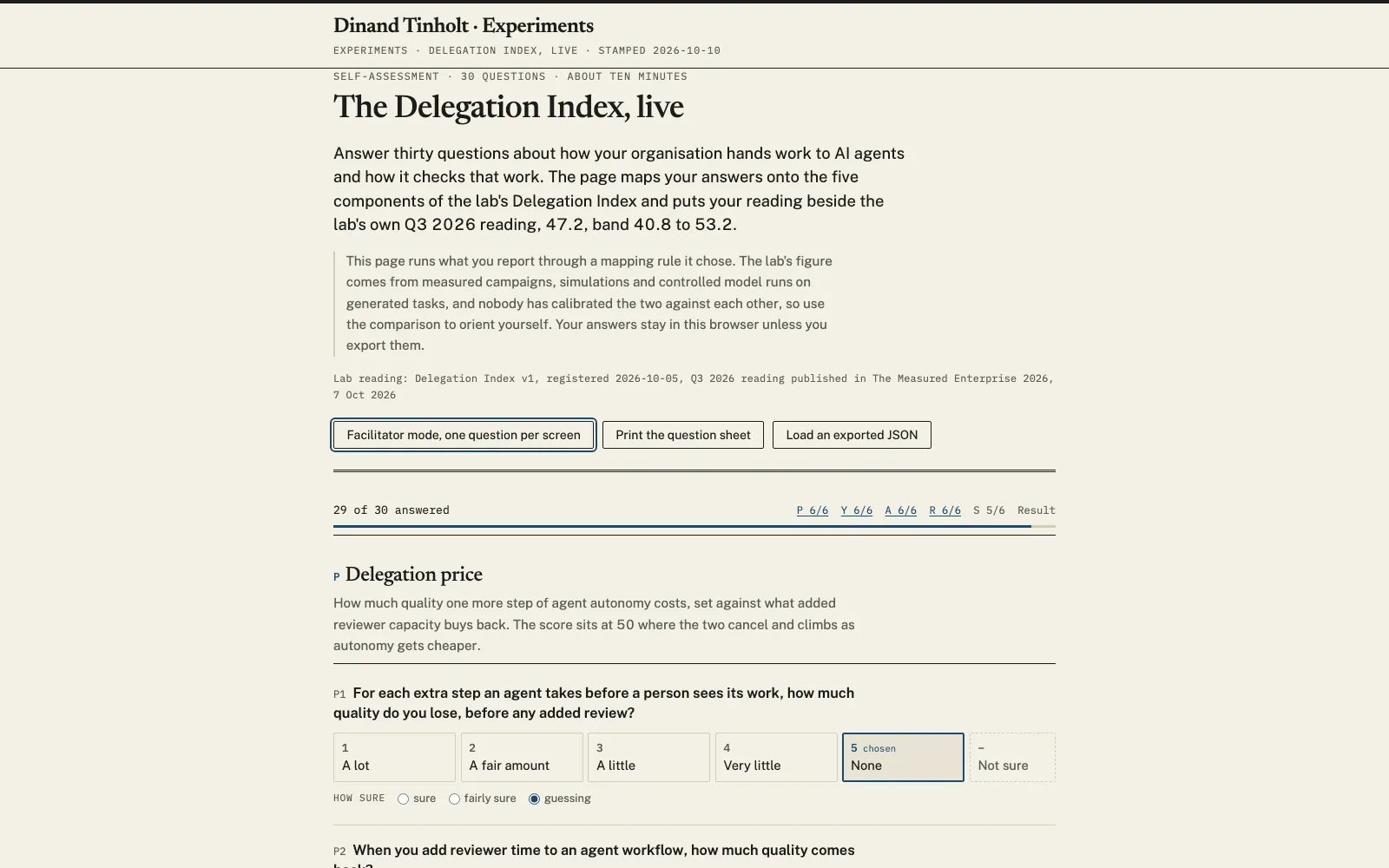
The Delegation Index, live is a self-assessment. An organisation answers thirty questions about how it hands work to AI agents and checks that work, and a stated rule maps the answers onto the five components of the Delegation Index. Your reading sits beside the lab's Q3 2026 reading of 47.2, band 40.8 to 53.2.
What it does
Six questions go to each component: delegation price, oversight yield, audit detection, reviewer independence and sprawl. Each answer turns into a score through rule dil-1. You can mark any answer as a guess, and the band widens while the score stays put. Under each ruler your answers sit beside the campaign figure the lab measured, quoted with its claim id. A short table shows which single answer carries the most weight in the arithmetic.
In a workshop, facilitator mode puts one question on the screen at a time, and a printable sheet works for rooms without laptops. Export a reading as JSON and load it back later, or load two exports to put two teams, or one team a quarter apart, on the same rulers. A worked appendix rebuilds any component of the lab's own reading from its published inputs, step by step.
How to use it
Open the tool and answer the questions in order, or open it with the demo answers loaded to see a finished reading first. Mark how sure you are of each answer, then scroll to the result for the rulers and the needle table.
Your draft stays in this browser, and nothing leaves it unless you export.
What it does not do
The page and the index are separate instruments. The index reads the lab's measured synthetic campaigns. This page runs self-report through a mapping rule I chose, and nobody has calibrated that rule against measured oversight, so treat the comparison as a way to get your bearings.
The confidence allowances and the pattern thresholds are design choices. The needle table is arithmetic on your own answers and gives no advice. Pooled readings would need a collection step that this page leaves out.
Where the numbers come from
The index construction (version 1, registered 5 October 2026) and the Q3 2026 reading with its component bands come from The Measured Enterprise 2026, published 7 October 2026. The cards headed What the lab measured quote the claims register: Delegation Cliff at −1.50 per step of depth and +1.46 for reviewer capacity, SIGIL at a tier-5 value of −3.81 against −2.64, Trial Balance at 0.58 for the best log review, Error Independence at a mean cross-family correlation of −0.102, and AGENESIS-2 at an exponent of 1.4665 with cost ×2.76 per doubling.
- The Measured Enterprise 2026
- Every public headline number
- Sprawl Cost Under a Fixed Monitoring Budget
- Error Independence
Open the tool
The page opens on the first question. A self-check of 164 tests runs in the console on every load. It runs in your browser and sends nothing anywhere.
Open the tool Full screen in a new tab Open with the demo answers